What are best practices for increasing my chances of being successful using Crystal Clear™ EU resins?
Crystal Clear™ EU resins are a unique class of resin that can yield spectacular clear casting results. Following directions and, in some cases, experimentation may be necessary for success depending on desired results. A small-scale test prior to using it for a large-scale project is recommended to understand how a particular resin performs.
If you are new to casting, do not use any Crystal Clear™ EU resin. There is a lot that can go wrong with these resins, especially for beginners. You may want to consider hiring an experienced casting professional for your Crystal Clear™ EU project. We have a listing of professionals here:
https://www.smooth-on.com/page/moldmaker/
Best Practices
Before you buy any Crystal Clear™ EU resin product, make sure you fully understand the technical bulletin. If directions are not followed, it could result in partially or fully uncured resin, bubbles, warping, shrinkage, yellowing, fish-eyeing, suck back (also known as corner rounding), in or on the surface of the finished casting.
What Variables Must You Consider Before Choosing a Crystal Clear™ EU Resin?
The Crystal Clear™ EU technical bulletin offers a guide on which Crystal Clear™ EU product to choose based on casting thickness.
Environment: Store and use at room temperature with a relative humidity below 50%. Once the container is opened, use resin as soon as possible.
Casting Configuration - Casting Configuration and amount of resin to be mixed and poured at one time will determine the Crystal Clear™ EU resin product you choose. For example, a flat panel casting with a thickness of no more than 3/8” (1 cm) in a mold measuring 12” x 12” (30 cm x 30 cm) could be achieved with Crystal Clear™ 200 EU or 202 EU. Casting into a mold cavity with the size and shape of a bowling ball could be achieved with Crystal Clear™ 204 EU, 206 EU or 220 EU.
Casting Thickness - Crystal Clear™ EU resins are formulated for specific ranges in casting thickness:
-
Crystal Clear™ 202 EU: 1/16" to 1/2" (.16 cm to 1.25 cm) thick.
-
Crystal Clear™ 200 EU: 1/2" to 3" (1.25 cm to 7.5 cm) thick. Maximum casting weight: 16 lbs (7.25 kg).
-
Crystal Clear™ 204 EU: 3" to 6" (7.5 cm to 15.25 cm) thick. Maximum casting weight: 35 lbs (15.88 kg).
-
Crystal Clear™ 206 EU: Greater than 6" (15.25 cm) thick.
-
Crystal Clear™ 220 EU: 1/2" to 3" (1.25 cm to 7.5 cm) thick. Suitable for industrial applications that require higher heat deflection (HDT 176°F / 80°C). The cured resin is harder and is a good choice for prototyping, making lenses, electronic potting and similar applications.
Mass Sensitive - How Much Will You Be Mixing and Pouring at One Time? Crystal Clear™ EU resins are mass sensitive. Using the wrong resin for your project will result in failure. For example, using Crystal Clear™ 202 EU to cast the configuration of a bowling ball will generate tremendous heat (exotherm) and result in discoloration, surface imperfections, shrinkage and warping. Using Crystal Clear™ 204 EU to cast a flat panel 3/8” (1 cm) thick may never fully cure or will easily distort at room temperature when handled.
Make sure you follow directions on the technical bulletin for:
-
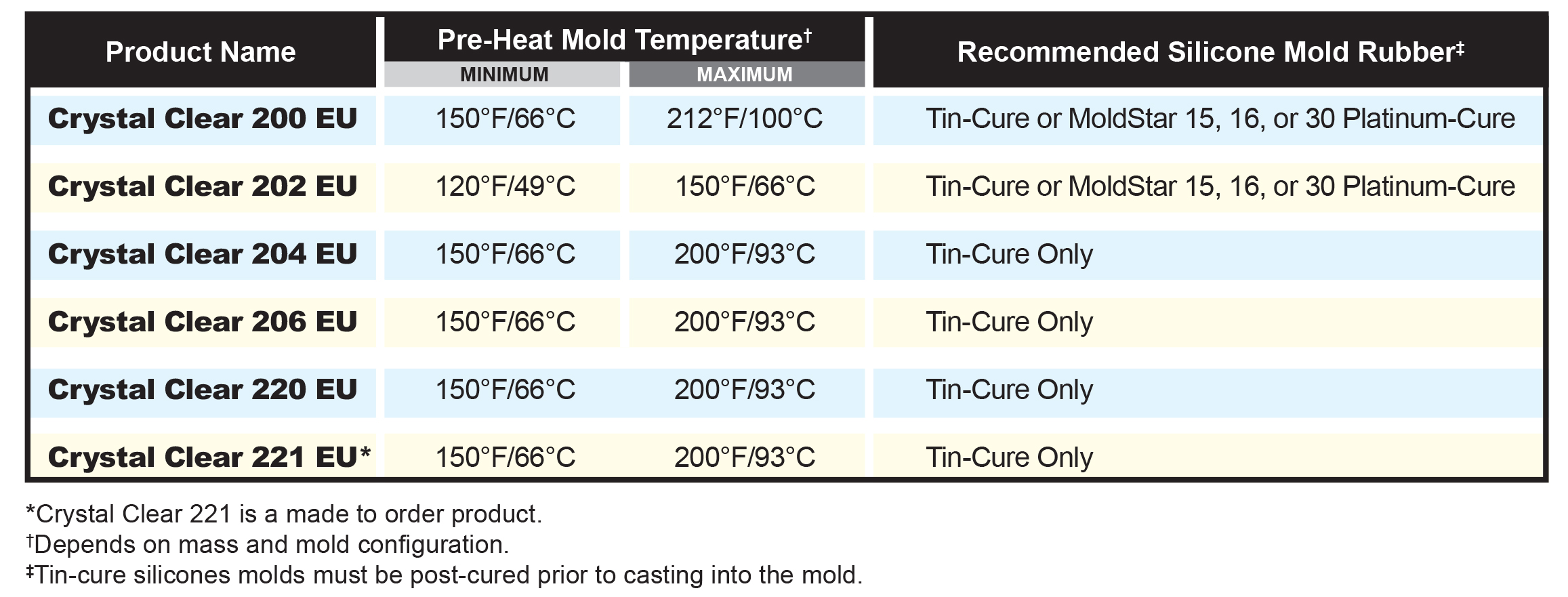
Using the Right Mold Rubber - Crystal Clear™ EU resins do not work with some types of mold rubber. Best results are achieved with a tin or platinum cured silicone molds. Tin-cured silicone mold products include Mold Max 20, 25, 30 or STROKE. Platinum-cured silicone mold products use only Mold Star 15, 16 or 30. Do not use Mold Max™ T or Mold Star™ T Series, or any other mold rubber.
-
Heat is Important* – Pre-Heat the mold before mixing and pouring Crystal Clear™ EU resin. Post curing the finished casting with heat is also recommended.
Demolding Your Casting
Unfortunately, it is not until you demold your casting that you find that the outcome was successful or there are issues either in the casting, on the surface or both. Depending on your outcome, there may be ways to address the problem. Here are a few ideas:
|
Your Casting is Exhibiting |
Possible Solution |
|---|---|
| Shrinkage* | Lower Pre-Heat Temp of Mold |
| Yellowing* | Lower Pre-Heat Temp of Mold |
| Suck Back at Corners* | Increase Pre-Heat Temp of Mold |
| Worm Trails/Orange Peel on Surface | Increase Pre-Heat Temp of Mold |
| Fracturing / Cracking | Lower Pre-Heat Temp of Mold |
| Partial Cure / Sticky Surface | Inadequate mixing of Parts A and B. Use ‘double mix and pour’ technique. |
| Partial Cure / Sticky Surface | Post Cure a Tin-Cure Mold Before Casting |
| Partial Cure / Sticky Surface | Increase Pre-Heat Temp of Mold Before Casting |
*The overall issue may be that the resin is too fast for the size and configuration of the casting.
Bubbles
Bubbles in your finished casting is a broad topic because they can come from many different sources including over aggressive mixing, humidity in the air, moisture on a mold surface and more. Smooth-On has other FAQ’s that address bubbles in castings.
Bubbles FAQ; https://www.smooth-on.com/support/faq/131/
Your best protection against bubbles is either vacuuming the resin prior to casting into a mold; https://www.smooth-on.com/tutorials/vacuum-degas-urethane-resin-smooth-cast-326/
or pressure casting: https://www.smooth-on.com/tutorials/eliminate-bubbles-resin-castings-pressure-casting/
Important: moisture will cause your Crystal Clear™ EU product to bubble or foam. Make sure the compressed air supplied to your pressure tank is dry. To ensure dry air is being delivered by your compressor, you can use an in-line dryer / desiccant filter such as: https://a.co/d/02LeBSpx
Repairing Cured Castings – in some cases, a cured casting with minor defects (fish eyes or worm trails) can be repaired. Sand surface with 220 grit sand paper and blow out with compressed air. Fill with newly mixed Crystal Clear™ 200 EU or 202 EU. Slightly overfill defect until you see a dome. Let resin fully cure. Sand and polish. Re-sand and polish as needed.
Air hole repair – some air holes can be repaired by drilling into the air hole, blowing out excess debris and filling with newly mixed resin.
See Polishing FAQ for further information: https://www.smooth-on.com/support/faq/151/